
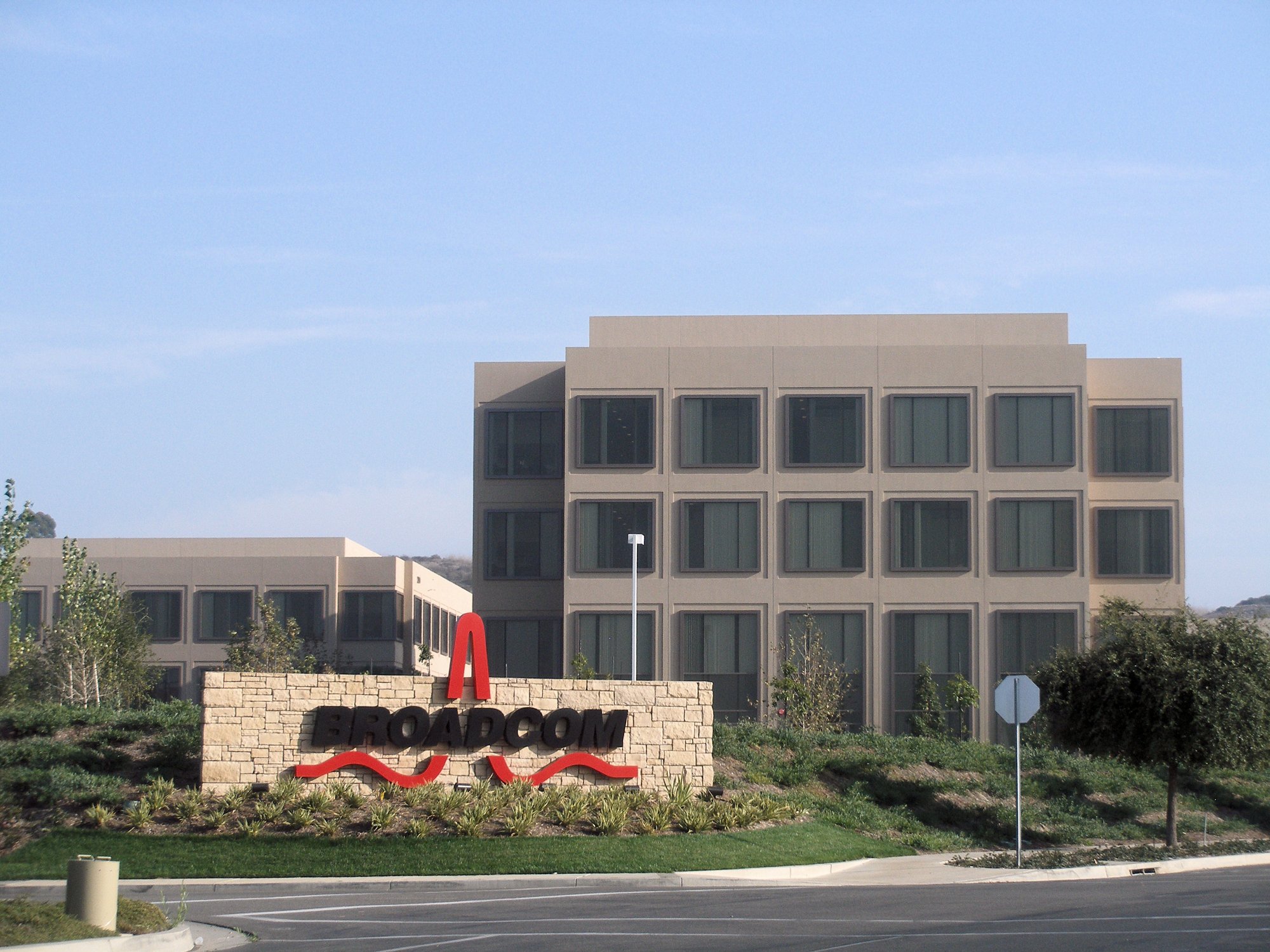
Broadcom (NASDAQ: AVGO) stock rebounded on Monday, November 23, recovering part of Friday’s steep decline as Nvidia’s powerful rally lifted semiconductor shares. AVGO traded at $309.89, up 1.80%, at 2:46 p.m. Eastern Time, compared with its November 20 closing price of $304.41.
The modest recovery followed a 12.19% plunge on Friday after supply-chain analyst Ming-Chi Kuo reported that Google had reduced planned 2027 shipments of Broadcom-designed artificial intelligence chips by approximately one million units. Goldman Sachs had separately lowered its Broadcom price target from $540 to $460 on November 18 while maintaining its Buy rating.
Nvidia shares surged approximately 31% during Monday’s session, helping reverse a broader technology selloff. Broadcom’s much smaller gain suggested investors were still weighing the potential effect of Google’s reported chip allocation changes on its custom AI silicon business.
AVGO Stock Recovers After Friday’s 12% Decline
Broadcom closed at $304.41 on Friday, November 20, down 12.19% for the session. The decline coincided with a broader technology selloff but accelerated as investors assessed reports that Google was reducing planned shipments of a key custom chip designed by Broadcom.
Monday’s rebound proved considerably smaller than gains elsewhere in the semiconductor sector. Nvidia climbed more than 30%, while other AI hardware companies also recorded double-digit advances. Broadcom opened at $320.86 and reached an intraday high of $324.46 before surrendering much of that advance.
At $309.89, Broadcom remained approximately 10.6% below its November 19 closing price. The recovery therefore reversed only a fraction of Friday’s losses, despite the broader improvement in investor appetite for AI-related stocks.
The divergence raises a company-specific question. Broadcom supplies networking components and custom accelerators used in large AI infrastructure deployments, but changes in Google’s semiconductor procurement plans could affect the revenue mix investors expect from its fastest-growing business.
What Ming-Chi Kuo Reported About Google’s TPU Orders
On November 20, TF International Securities analyst Ming-Chi Kuo said his latest industry survey indicated that Google had reduced planned 2027 shipments of its Broadcom-designed TPU 8i series by approximately one million units, equivalent to about 20% of the series’ expected volume.
The reported reductions were concentrated in higher-priced TPU 8i Max chips, also known as Whalefish. Kuo indicated that Google intended to increase shipments of the TPU 8t series designed by Taiwan’s MediaTek, although he acknowledged that the details of those plans had not been finalized.
The reported adjustment points to a possible change in Google’s AI hardware mix rather than necessarily indicating an equivalent reduction in total AI computing expenditure. The TPU 8t family is designed primarily for training AI models, while the 8i family targets inference workloads.
For Broadcom, the financial exposure depends on how many chips are ultimately removed from production plans, their average selling prices, the company’s share of each chip’s value and whether alternative orders can offset the reduction.
The reported one-million-unit change cannot be translated directly into a reliable revenue loss without those details. A reduction concentrated in higher-priced products could carry a disproportionate revenue or profit impact relative to the percentage decline in shipments.
The report remains an analyst’s supply-chain assessment, not a confirmed announcement from Google, Broadcom or MediaTek. No company disclosure independently confirming the proposed reduction in 2027 TPU 8i volumes had been identified as of Monday.
Broadcom’s existing relationship with Google is substantial. An April 2026 SEC filing disclosed a long-term agreement covering future generations of Google’s custom TPUs and networking components for next-generation AI racks, with arrangements extending through as late as 2031.
The same filing confirmed an expanded collaboration involving Anthropic, which is expected to access approximately 3.5 gigawatts of TPU-based compute capacity through Broadcom beginning in 2027. Anthropic’s position in the AI infrastructure market has received additional attention following its November Nasdaq debut after an $81 billion IPO.
Those agreements establish a broader commercial relationship than a single chip generation, but they do not guarantee that Google’s purchases of every TPU design will remain unchanged.
Goldman Sachs Cuts Broadcom Target but Maintains Buy
Goldman Sachs analyst James Schneider reduced Broadcom’s 12-month price target to $460 from $540 on November 18, a decrease of approximately 14.8%, while maintaining a Buy recommendation.
The timing is important: Goldman’s revision preceded Kuo’s November 20 supply-chain report. The target reduction therefore should not be interpreted as a direct response to that later claim about Google’s TPU 8i shipments.
The revised valuation reflected a reduction in the earnings multiple applied to Broadcom, from approximately 30 times to 25 times, amid lower valuations across comparable semiconductor companies.
At Monday’s $309.89 intraday price, Goldman’s $460 target represented approximately 48.4% potential upside. That remained a substantial difference even after the downgrade, reflecting the distinction between a lower valuation assumption and a negative investment recommendation.
The retained Buy rating does not resolve uncertainty about Google’s orders. Broadcom’s future share price will depend on whether earnings growth, customer commitments and margins support the valuation assumptions embedded in analyst forecasts.
Broadcom Remains 37% Below Its June Record
Broadcom’s shares have fallen substantially from their June 2026 peak. The stock reached a 52-week intraday high of $495 on June 3 and has traded as low as $289.77 over the past year.
At $309.89, AVGO was approximately 37.4% below that June high and about 6.9% above its 52-week low. The decline has sharply reduced the valuation investors are willing to assign to Broadcom’s expected AI growth.
The company’s most recent quarterly results nevertheless showed substantial expansion. Fiscal third-quarter revenue increased 86% year over year to approximately $29.6 billion, while AI semiconductor revenue reached $16.7 billion, representing 221% annual growth.
AI semiconductors accounted for approximately 56% of Broadcom’s total quarterly revenue, emphasizing their increasing importance to the group’s financial performance. Broadcom also generated $13.7 billion in quarterly free cash flow.
Management previously projected approximately $34.8 billion in fourth-quarter revenue, including $21.7 billion from AI semiconductors. That AI forecast implied growth of 236% from the corresponding year-earlier period.
The question for investors is whether reported changes to Google’s 2027 TPU plans alter the longer-term revenue trajectory or mainly redistribute future business among different custom-chip designs and customers.
Broadcom’s semiconductor operations also benefit from AI networking equipment and accelerator programs beyond Google, while its infrastructure software business provides another source of revenue. These businesses could cushion the effect of weaker orders from an individual chip program, although the extent of any offset remains uncertain.
December 9 Earnings Could Clarify Google’s Impact
Broadcom is scheduled to report fiscal fourth-quarter and full-year 2026 financial results after the U.S. stock market closes on Wednesday, December 9. Management will hold its earnings conference call at 5 p.m. Eastern Time.
The announcement will give investors an opportunity to compare actual fourth-quarter revenue against management’s $34.8 billion forecast and evaluate whether AI semiconductor sales approached the expected $21.7 billion.
More important for the current debate will be management’s outlook for fiscal 2027. Investors will be looking for updates on custom accelerator shipments, Google’s TPU product mix, revenue visibility from major AI customers and the contribution expected from networking products.
Any clarification regarding the reported one-million-unit TPU 8i reduction would help establish whether the change represents a material loss of expected Broadcom revenue, a timing adjustment or a reallocation of computing capacity within Google’s AI infrastructure plans.
Monday’s rebound demonstrates that AVGO can benefit from a wider semiconductor recovery, but its performance relative to Nvidia shows that investors have not dismissed the uncertainty surrounding Google’s reported procurement changes. Broadcom’s December 9 guidance will provide a more direct financial test of those concerns than the latest stock-price recovery.