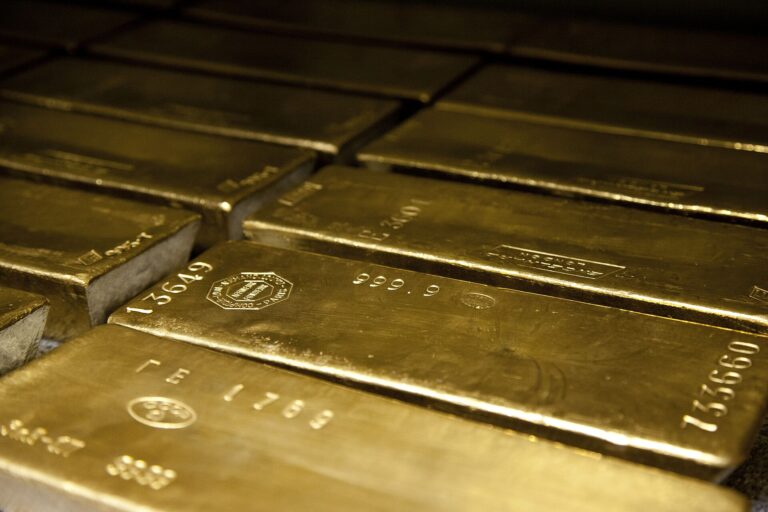
Gold fell below $4,000 an ounce on Friday, October 23, breaking the support level FinanceFeeds identified a day earlier, even as financial markets priced a nearly 93% probability that the Federal Reserve would leave interest rates unchanged at its October meeting.
Spot gold traded at $3,996.71 per ounce at 3:06 p.m. Eastern time on Friday, according to GoldPrice.com, after Reuters reported an intraday low near $3,975.23. The decline marked the metal’s weakest level since July 20, according to Reuters. October COMEX gold futures also settled below the psychological threshold, at approximately $3,991.10, according to Dow Jones market reporting.
The apparent contradiction is central to the gold price outlook. An October interest-rate increase has become unlikely, but investors continue to anticipate another hike in December as elevated oil prices sustain inflation concerns. Meanwhile, selling across technology stocks has forced some investors to raise cash by liquidating positions in precious metals.
Newmont’s latest quarterly results offer another perspective: even with gold around $4,000, the world’s largest gold producer reported all-in sustaining costs of just $1,454 per ounce, leaving a substantial indicative operating spread.
Gold Breaks the $4,000 Level After Thursday’s 2.8% Selloff
Gold’s decline accelerated on Thursday, October 22, when spot prices fell approximately 2.8%, losing about $117-$120 per ounce and finishing around $4,024, depending on the pricing source.
That move followed a break below the $4,095 support level identified in FinanceFeeds’ October 22 gold technical analysis, which highlighted $4,000 as the next important downside reference.
Friday’s trading confirmed that the level had been breached, although the significance of that break depends on whether subsequent sessions remain below it or recover.
Gold’s weekly decline approached 4%, according to Reuters, while silver, platinum and palladium also weakened. The synchronized selling suggests broader pressure across precious metals rather than an isolated move in gold.
Why Gold Fell Even as October Fed Hike Odds Dropped to 7%
The Federal Reserve‘s October 27-28 meeting is now widely expected to end without another interest-rate increase.
A CME FedWatch-based snapshot published on October 23 showed a 92.8% probability of rates remaining unchanged and a 7.2% probability of a 25-basis-point increase. Subsequent Friday readings from Reuters and other market monitors placed October hike expectations closer to 8%-10%.
Under normal circumstances, declining expectations for an imminent rate increase would support gold because the metal does not generate interest income.
However, the October probability tells only part of the story.
Friday’s Reuters reporting placed the market-implied probability of at least one additional rate increase by December at approximately 78%-81%. That is lower than the roughly 90% probability reported earlier in the week, but it still indicates that investors expect further monetary tightening before year-end.
In other words, the market has largely removed the immediate October hike while retaining substantial expectations for December.
This distinction matters because gold responds not just to the next policy decision but also to the expected path of interest rates and inflation-adjusted yields.
A pause next week would therefore not automatically represent a dovish policy shift if the accompanying statement and press conference reinforce expectations of December tightening.
Oil, the Dollar and Forced Selling Weigh on Precious Metals
Energy prices have complicated the relationship between gold and monetary policy.
Brent crude climbed above $110 a barrel during the week, with attacks affecting Saudi Arabia intensifying concerns about supply disruptions. Higher energy costs threaten to keep inflation elevated, reducing the Federal Reserve’s flexibility to ease monetary policy.
Capital Economics economist Hamad Hussain told Reuters that rising oil prices could keep real interest rates elevated for longer, reducing the relative attractiveness of holding gold.
However, the latest decline cannot be explained solely by rising bond yields. US Treasury yields also eased during portions of the technology-led equity selloff, without delivering the support that gold would normally receive.
Bloomberg and Reuters identified another mechanism: investors selling precious metals to cover losses and meet liquidity requirements elsewhere in their portfolios.
The dollar’s recovery from recent lows provided an additional headwind, although its contribution should not be confused with proof that currency movements alone caused the decline.
The combination helps explain why gold has failed to behave as a conventional safe-haven asset during this particular episode.
FinanceFeeds’ October 17 analysis of oil prices, Fed expectations and gold had already highlighted the tension between lower October hike probabilities and persistent December tightening expectations.
Newmont’s $1,454 Cost Shows What $4,000 Gold Still Means for Miners
Newmont Corporation’s third-quarter results, filed with the SEC on October 22, demonstrate that falling bullion prices do not translate directly into losses for established gold producers.
The company reported attributable gold production of approximately 1.3 million ounces, with by-product costs applicable to sales of $832 per ounce and all-in sustaining costs of $1,454 per ounce.
Newmont realized an average gold price of $4,317 per ounce during the quarter, implying a spread of $2,863 per ounce over its reported all-in sustaining cost.
At a hypothetical realized gold price of $4,000, that spread would narrow to $2,546 per ounce, approximately 11% below the third-quarter figure, assuming costs remained unchanged.
That calculation is an indicative price-minus-AISC spread, not the company’s accounting profit per ounce. All-in sustaining costs exclude certain corporate, financing, tax and development expenditures, while by-product credits also affect the reported measure.
Newmont’s actual results were substantial. The company generated adjusted earnings of $2.20 per diluted share, free cash flow of $1.9 billion and ended September with $8.8 billion in cash.
It also declared a quarterly dividend of $0.26 per share and improved its full-year all-in sustaining cost guidance to $1,520 per ounce.
The key implication is that gold near $4,000 remains highly profitable on an AISC-spread basis for Newmont, even though additional price declines would reduce that cushion.
October 28 Fed Decision and October 29 PCE Will Set the Next Test
Gold traders face two consecutive US macroeconomic events next week.
The Federal Reserve announces its policy decision on Wednesday, October 28, at 2:00 p.m. Eastern time, followed by Chair Kevin Warsh’s press conference at 2:30 p.m.
The immediate decision is heavily priced as a hold. The more consequential information will be whether policymakers reinforce, weaken or leave unchanged expectations for another rate increase in December.
On Thursday, October 29, the Bureau of Economic Analysis releases September’s Personal Consumption Expenditures inflation report at 8:30 a.m. Eastern time.
A stronger-than-expected inflation reading could reinforce December tightening expectations, while softer inflation might undermine the rate outlook currently weighing on gold.
For the gold price, $4,000 now becomes the immediate psychological reference. A sustained recovery above it would weaken the significance of Friday’s breakdown, while continued trading below the threshold would keep attention on the $3,940-$3,960 area identified by several technical analysts.
For gold-mining investors, Newmont’s $1,454 all-in sustaining cost provides a separate measure of resilience. The central question is whether bullion prices stabilize before further declines begin materially compressing producers’ operating spreads and future cash generation.